

Proposal Development
[ON THIS PAGE BLOCK]
Proposal Submission process
Initial Stages
- Before beginning the proposal, PI reviews guidelines for the application process and requirements.
- PI works with department and research dean’s office(s) on preliminary aspects of the proposal.
- PI identifies required resources and personnel need for the project.
- PI begins writing the technical/narrative portion of the proposal and develops the budget.
- PI works with the OSP Grant Specialist responsible for budget review to finalize budget.
OSP Submission Deadlines
- The complete and final proposal, accompanied by the necessary department-level approvals, as well as any other attachments or approvals required by the sponsor or the University, must be received by OSP at least five (5) full business daysprior to the sponsor’s due date.
- Sponsor due date is defined as the date and time after which sponsor will no longer accept proposals.
- When UNCG is a subcontractor, sponsor due date determined by the submitting institution.
- For proposals submitted directly through a sponsor’s external web portal (ASSIST, Research.gov, NSPIRES, etc.) the proposal must be released to the AOR (authorized organizational representative) for submission within the sponsor’s web portal BEFORE the funding proposal is routed to the OSP Grant Specialist in Cayuse. Both the funding proposal and proposal must be in the AOR/Grant Specialist state in both Cayuse and the sponsor’s web portal prior to the 5-day deadline. If this does not occur, the Cayuse proposal will be returned to the department.
Green-Yellow-Red Priority System
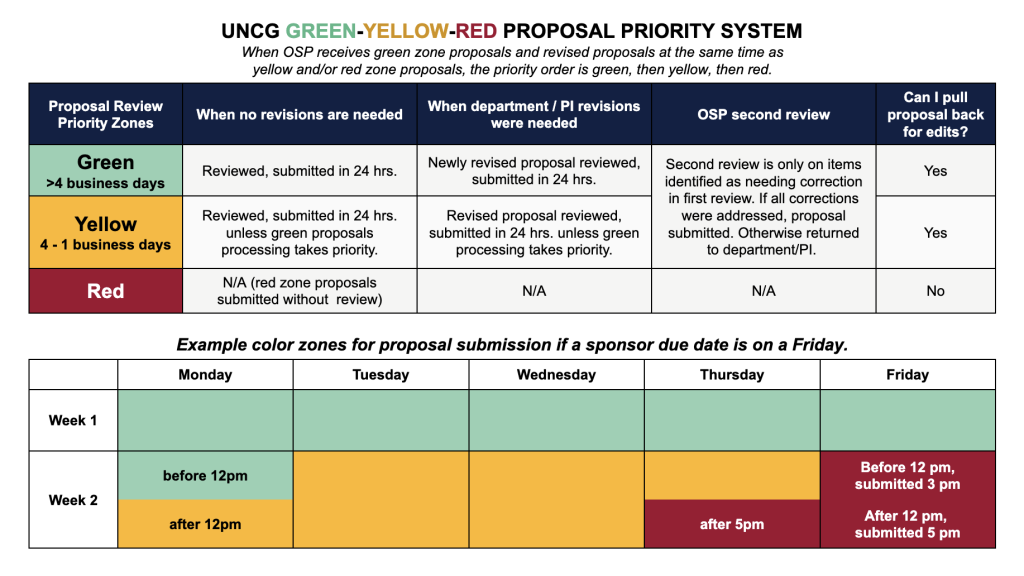
- Proposals OSP receives at least five full business days prior to the sponsor due date are considered green zone submissions.
- Proposals OSP receives between 3 business days and 1 business day before the sponsor due date, are yellow zone submissions. Yellow zone submissions are lower priority than green zone submissions, in terms of OSP turnaround for review, corrections, and submission to sponsor.
- Proposals received within 1 business day of the sponsor due date are red zone proposals. These will be submitted without review.
See the table below for more details on the review process according to the green-yellow-red priority system.

budget development
The budget is one of the most essential components of a proposal. The budget development process can sometimes be difficult because of the various components, policies, rates, and other factors that need to be taken into consideration. The following information is intended to highlight the basic elements included in a budget and provide an overview of the budget preparation and review process at UNCG. The budget is generally divided into two classifications: Direct Costs and Facilities & Administrative Costs (also referred to as “F&A,” “indirect,” or “overhead” costs).
Matching Funds/ Cost-Sharing
If sponsor guidelines require cost-sharing or matching funds (cash contribution or donation of in-kind services such as contributed time and effort by the Principal Investigator and research group members), you must ensure that the monetary value of the matching funds is accounted for in the budget and in Cayuse. All matching funds or cost-sharing commitments based on the faculty member’s academic time and effort should be approved in advance by the Principal Investigator’s department chair and dean. If the sponsor does not require cost-sharing or matching funds, it is generally discouraged to obligate UNCG to committed cost share. Please consult with OSP staff to ensure that cost share accounting is handled correctly.
Get started now: UNCG Internal Proposal Budget Template with Cost Share (up to 5 years)
Subawards
Some proposals represent a collaboration of work by more than one institution. Costs of such other institutional collaborations are represented in the budget as a single line item and are generally accompanied by a separate subcontractor budget and budget justification.
- The subaward total budget includes both direct and F&A costs in a single line item on the prime institution’s proposal budget.
Direct Costs
F&A Costs
Facilities & administrative costs (F&A, “overhead,” “indirect”) are incurred for expenses that cannot be identified readily and specifically with a particular sponsored project. The cost of building operations and maintenance, equipment upkeep, general and departmental administrative expenses, sponsored projects’ administration, and library expenses are usually considered indirect costs. These costs are essential to the support of sponsored program activities. Facilities & administrative costs are split post-award by 80% going to the university to support research, 10% to the principal investigator, and 10% to the home department(s) or unit(s) identified.
F&A Guidelines
UNCG’s F&A rates are based on a federally negotiated agreement that is unique to UNCG. One important element of federal guidelines is that we apply our negotiated F&A rates similarly across all sources of funding. To remain in compliance with federal policy, our federally negotiated rates must be used in all sponsored agreements unless the sponsor has an explicit policy regarding indirect costs that dictates another rate be used by all proposal applicants.
- Sponsors with explicit policies regarding indirect costs can dictate another rate. In these cases we will apply the sponsor’s stated rate (please include the sponsor’s documentation in your proposal routing). This situation is more likely to arise with working with non-Federal sponsors (e.g., State of North Carolina agencies, local governments, industry and foundations). However, there are situations in which federal agencies will cap the amount of F&A they allow. This information will be stated explicitly in the RFA/RFP. Where the federal sponsor’s stated indirect cost rate is less than the University’s approved rate, the sponsor’s limited rate should be applied. Some examples of federal limitations are training grants and research career development awards, which limit indirect cost recoveries to 8% of total direct costs. If you are unsure of an organization’s policy related to F&A, please contact your Proposal Specialist. They can reference previous agreements to determine F&A rates and/or contact organizations to inquire about their policy.
- On- and Off-Campus Rates. Off campus rates are generally used when the sponsored research takes place (or predominantly takes place) in a facility not owned by the University and to which rent is directly allocated to the project. Please note that rates on an individual project may no longer be split between on- and off-campus rates. If more than 50% of a project is performed off-campus, the off-campus rate will apply to the entire project. Otherwise, the on-campus rate applies. Prior to submitting your proposal, please contact OSP for assistance.
Calculating F&A Costs
UNCG’s federally negotiated on-campus research F&A rate is 47% of Modified Total Direct Costs (MTDC). To calculate the F&A costs for a project:
- Calculate the Total Direct Costs (TDC) which is simply the sum of all direct costs (salaries, benefits, supplies, equipment, etc.).
- Calculate the base against which the F&A rate will be multiplied by subtracting exempt items (e.g., capital equipment, graduate student tuition and required fees, and subcontract/subrecipient agreement costs in excess of the first $25,000 of each subcontract/subrecipient agreement over the life of the subcontract/subrecipient agreement) from TDC. This will give the MTDC.
- Apply the F&A rate against the MTDC base to calculate the F&A costs for the project.
- Add the TDC to the F&A to calculate the Total Project Costs.

Pre- and Post-submission requests
Pre-award Budget Revisions
Once a proposal has been submitted, the sponsor may decide to fund the project but at a reduced level of funding. If this is the case, the sponsor will typically notify UNCG or the PD/PI regarding the requested budget revision. The sponsor request may include a total project amount, due date for the revision, and an explanation of how the budget revision should be submitted and the required materials. This will vary by sponsor. When a budget revision is requested prior to award, a revised internal budget and budget justification must be submitted to OSP for review. OSP will work closely with the PI/PD to ensure that the revised budget is in compliance with both the sponsor request and, where applicable, with University policy. Unless the revision involves additional cost-sharing, or significantly affects the proposed F&A calculations, the revised budget materials do not need to go through the same approval channels as the original proposal (OSP can assist with making the determination). Once finalized, the revised budget, budget justification, and a pdf copy of the budget revision request should be uploaded to the original Cayuse proposal submission file for internal tracking purposes. As a final step, OSP will review all budget materials, ensuring the revision is in the proper format, and will work directly with the sponsor to submit.
NIH Just-in-Time Requests
A Just-in-Time Request for information is normally sent to PIs who have applied for NIH funding and are in the late-stages of the review process. Information usually requested includes: updated Other Support documents, IRB and IACUC certifications, and often, revised budgets. More information can be found on the NIH site.
Post-award Budget Revisions
Often a sponsor will recommend funding but at a reduced level. In this instance, before an award can be issued, a revised budget must be submitted to the sponsor. Please work with your Grants Specialist in the Office of Contracts and Grants to develop your revised budget. OSP is responsible for the final review, approval and submission of all post-award budget requests.
NIH Post-Submission Application Materials
- News of promotions and positive tenure decisions.
- News of promotions and professional achievements for trainees and faculty members on training grant applications.
- Revised budget page(s) (e.g., change in budget request due to new funding or institutional acquisition of equipment).
- Biographical sketches (e.g., change in senior/key personnel due to the hiring, replacement, or loss of an investigator).
- Letters of support or collaboration resulting from a change in senior/key personnel due to the hiring, replacement, or loss of an investigator.
- Adjustments resulting from natural disasters (e.g., loss of an animal colony).
- Adjustments resulting from change of institution (e.g., PD/PI moves to another university).
- News of an article accepted for publication (a copy of the article should not be sent).


Data management policies
A Data Management Plan (DMP) is a formal document outlining how data will be managed during and after a research project. The goal of a DMP is to consider the man aspects of data management, metadata generation, data preservation, and analysis before the project begins with the goal of data being well-managed in the present and prepared for preservation in the future.
Elements of a DMP
Funding agencies (i.e. NSF and NIH) have established specific criteria for what must be included in a DMP. You should review specific guidelines for data management planning from the funding agency you are working with. Elements of your DMP may be reused in your protocols and in the Institutional Review Board (IRB) and methodology descriptions.
- Types of data
- What is the source of your data?
- In what formats are your data?
- Will your data be fixed, or will it change over time?
- How much data will your project produce?
- Contextual details (metadata)
- How will you document and describe your data?
- Storage, backup, and security
- How and where will you store and secure your data?
- Provisions for protection/privacy
- What privacy and confidentiality issues must you address?
- Policies for re-use
- How may other researchers use your data?
- Access and sharing
- How will you provide access to your data by other researchers?
- How will others discover your data?
- Archiving and providing access
- What are your plans for preserving the data and providing long-term access?
- Will the data be stored in an online repository?
- Roles and plan oversight
- Who will be responsible for aspects of data management throughout the project, and what resources are required for implementation?
Writing a DMP
The DMPTool is a web-based platform offering templates and guidance to help you create a comprehensive Data Management Plan (link to DMP General tab). Using DMPTool, researchers can access a template, example answers, and guiding resources to successfully write a data management plan for any research project or grant. The tool includes many templates for federal and private funders including NIH, NSF, Department of Defense, Department of Energy, and National Oceanic and Atmospheric Administration.
- Go to DMPTool
- Enter your UNCG email address in the “Sign in / Sign up” box and click “Continue”
- You should receive a prompt that “Your address is associated with: The University of North Carolina Greensboro (uncg.edu)”
- Click “Sign in with Institution (SSO)”
- Enter your UNCG credentials when prompted and click “Sign In”
Once logged in, you may create DMPs for your project using a template for your funding agency.
- Plans can be exported into Microsoft Word or PDF formats to include in a grant application.
- There is an option to create test plans. There is also a generic template if you wish to create a plan not associated with any funder.
Useful Articles
- Ten Simple Rules for Maximizing the Recommendations of the NIH Data Management and Sharing Plan
- Foundational Practices of Research Data Management, Research Ideas and Outcomes
- Forecasting Costs for Preserving, Archiving, and Promoting Access to Biomedical Data (provides researchers with an overview of existing repositories for research data)
- The FAIR Guiding Principles for Scientific Data Management and Stewardship
Example DMPs